


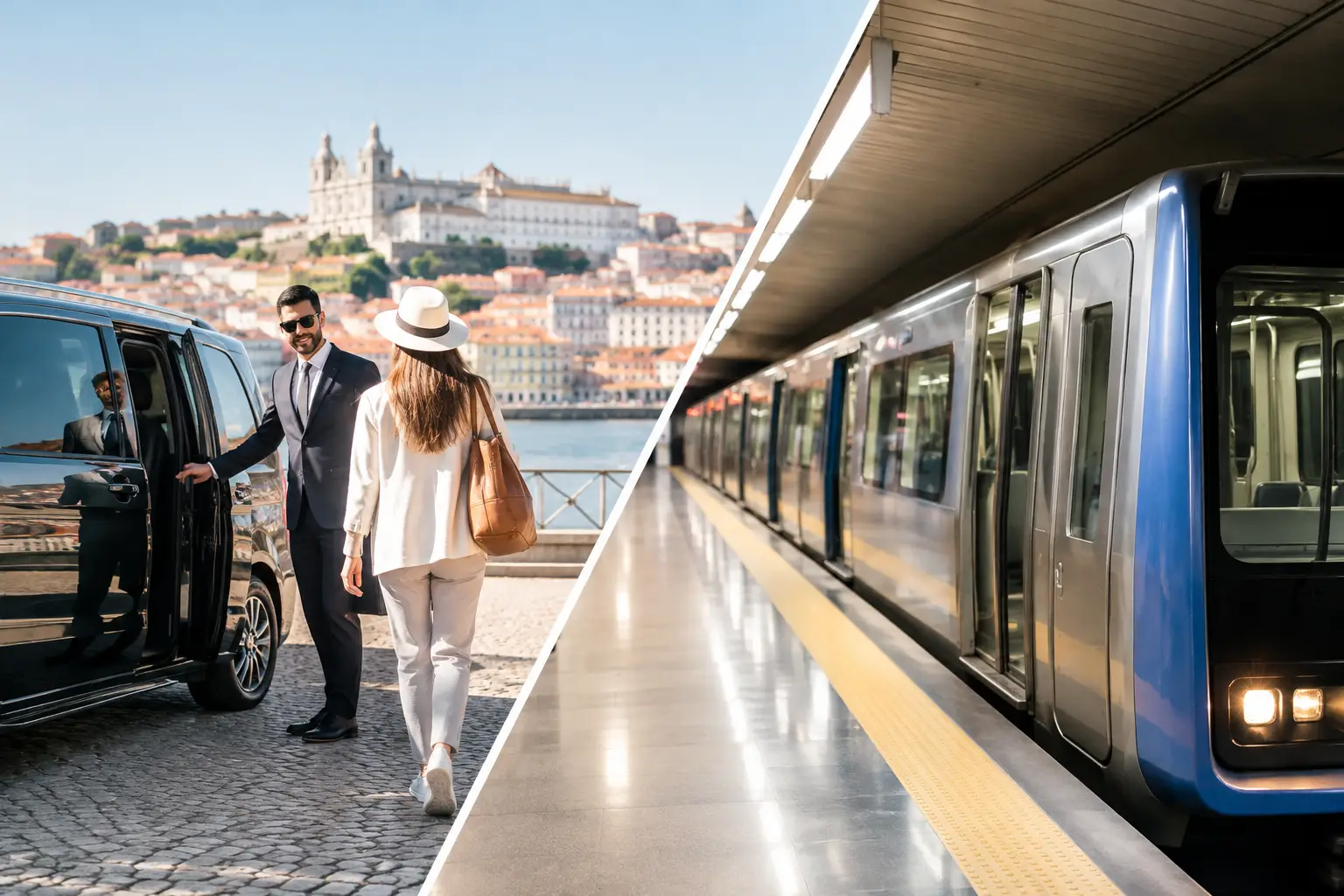
After a night flight, the Lisbon transfer or metro question is rarely only about price. It is about arriving at your hotel with luggage, finding the right entrance on streets that can be steep and cobbled, and deciding how much energy you want to spend on logistics before your holiday has properly begun.
For some travellers, Lisbon Metro is an efficient and sensible start. For others, a pre-booked private transfer is the calmer choice, particularly when travelling with children, several suitcases, older relatives or a group. The best option depends on where you are staying, when you land and what you want your first hours in Portugal to feel like.
Lisbon transfer or metro: the practical difference
Lisbon Airport is well connected to the city by the Red Line of the metro. It is a straightforward option for independent travellers staying near a station, travelling light and arriving during normal operating hours. From the airport, you may need to change lines to reach central neighbourhoods such as Baixa, Chiado, Avenida da Liberdade or Cais do Sodré.
A private transfer is a pre-arranged service with a driver waiting at the airport at an agreed meeting point. Your destination, passenger numbers and luggage requirements are considered before you arrive. Rather than working out ticket machines, platforms and interchanges, you travel directly to your accommodation.
Neither is automatically better. The metro rewards flexibility and a light itinerary. A transfer prioritises comfort, timing and door-to-door support.
When the metro is the right choice
The metro can work very well if you are a couple or solo traveller with one manageable bag each, your accommodation is close to a station and you are comfortable using public transport in a new city. It is also an appealing choice if you arrive in the daytime and want to keep your airport journey simple and economical.
Lisbon Metro is clean, generally easy to understand and useful beyond the airport trip. Buying a reusable travel card gives you a practical way to move around the city during your stay. The airport station is inside the terminal area, so you do not need to look for a separate bus stop or taxi rank.
There are, however, details worth considering. A metro journey to the historic centre often involves a line change, and stations may still leave you a walk from your hotel. That final stretch can be less pleasant than it looks on a map. Alfama, Bairro Alto, Graça and parts of Chiado are known for hills, narrow pavements and traditional Portuguese cobblestones. Pulling a large suitcase uphill after a flight can quickly turn a budget-friendly decision into a tiring arrival.
The metro also follows fixed operating hours. If your flight lands late, is delayed, or you need time for baggage collection and passport control, check the current timetable before relying on it. Services can also feel less comfortable when you are carrying bulky luggage during busy periods.
The metro suits travellers who value independence
Choose the metro when the journey itself feels manageable rather than like a compromise. If you know your hotel is a short, level walk from a station and you are happy to make an interchange, it is a good way to begin exploring Lisbon at your own pace.
It may be less suitable if you are arriving with a pram, sports equipment, multiple cases or a person who would find stairs, walking and changing platforms difficult. Saving money at the airport should not mean starting your holiday exhausted.
When a Lisbon airport transfer is worth it
A private transfer is especially valuable after a long-haul flight from Brazil, when the practical tasks of arrival can feel greater than expected. Even if the flight is direct, you still have baggage collection, arrivals formalities and the adjustment to a different time zone before reaching your hotel.
With a pre-booked transfer, a driver meets you after landing and takes you to your chosen address. This is useful for accommodation in areas where vehicles cannot always stop directly outside the door. Your driver can bring you as close as access allows, helping avoid the uncertainty of navigating unfamiliar streets with luggage.
For families and small groups, the calculation changes further. A metro journey may be inexpensive per person, but it requires everyone to manage their own bags, tickets and connections. A private vehicle lets the group travel together and gives parents more room to focus on children rather than platforms and directions.
Transfers are also a practical option for early departures. Leaving a central hotel for the airport before metro services begin can otherwise require arranging a taxi at an inconvenient hour. A confirmed pick-up time brings welcome reassurance when there is a flight to catch.
Privacy and flexibility matter for groups
A private transfer is not only transport. It creates a calm, private space between the airport and your accommodation, with no need to share the journey with strangers or divide the group across carriages. For a couple celebrating a special trip, a multi-generational family or friends travelling together, that comfort can be part of the experience.
It also allows for planning around your actual needs. The right vehicle size matters when there are six passengers and six large cases, for example. Booking in advance means those requirements can be discussed before the day of travel, rather than hoping a vehicle at the rank will have enough space.
Consider your Lisbon neighbourhood, not just the airport
Your hotel location is often the deciding factor. If you are staying near Oriente, Saldanha, Avenidas Novas or another well-connected modern area, the metro may be particularly convenient. These neighbourhoods tend to have wider streets and easier access from stations.
If your accommodation is in Alfama, Mouraria, Bairro Alto, Príncipe Real or a small guesthouse on a hill, a transfer is usually more comfortable. Lisbon’s most atmospheric districts are also the ones where navigation can be least direct. A route that appears short can include steep climbs, staircases or streets where cars have limited access.
Flats can add another layer. Unlike larger hotels, they may not have a staffed reception or obvious entrance. If you need to meet a host at a precise time, a direct transfer makes it easier to arrive as planned. Share the address and any access instructions when arranging the service, particularly if the property is inside a restricted street.
Cost is more than the fare
The metro has the lower direct cost. A transfer costs more because it includes a private vehicle, driver, fuel, waiting arrangements and door-to-door service. Yet the right comparison is not simply one fare against another.
Think about the number of passengers, the amount of luggage and the time you might spend navigating. A group of four may find that the difference between public transport and a private arrival service feels reasonable once convenience is included. The same applies when a taxi queue is long, your flight arrives at an awkward time or you have a reservation that leaves little room for delays.
A pre-booked transfer also provides clarity. You know who is meeting you, where to go after arrivals and what vehicle has been arranged for your party. That is different from deciding between a taxi, ride-hailing app or public transport after you land, perhaps without reliable mobile data.
A simple way to choose
Ask yourself three questions. Can everyone carry their luggage comfortably through an interchange and the final walk? Is your accommodation genuinely close to a metro station, with an easy route from it? And does your arrival time fit comfortably within metro operating hours?
If the answer is yes to all three, the metro is likely a practical choice. If any answer gives you pause, a private transfer is likely to deliver better value for your first day in Lisbon.
For travellers who want their arrival to be organised from the moment they leave the terminal, PortuCaleTravel can arrange private transfers around your flight, group size and accommodation, with local support in Portuguese. It is a particularly useful starting point if your Lisbon stay continues with private tours to Sintra, Cascais, Fátima or other destinations.
Lisbon rewards unhurried travellers. Choose the airport journey that lets you arrive with enough energy to notice the tiled façades, pause for a first coffee and enjoy the city rather than wrestle with your luggage.