



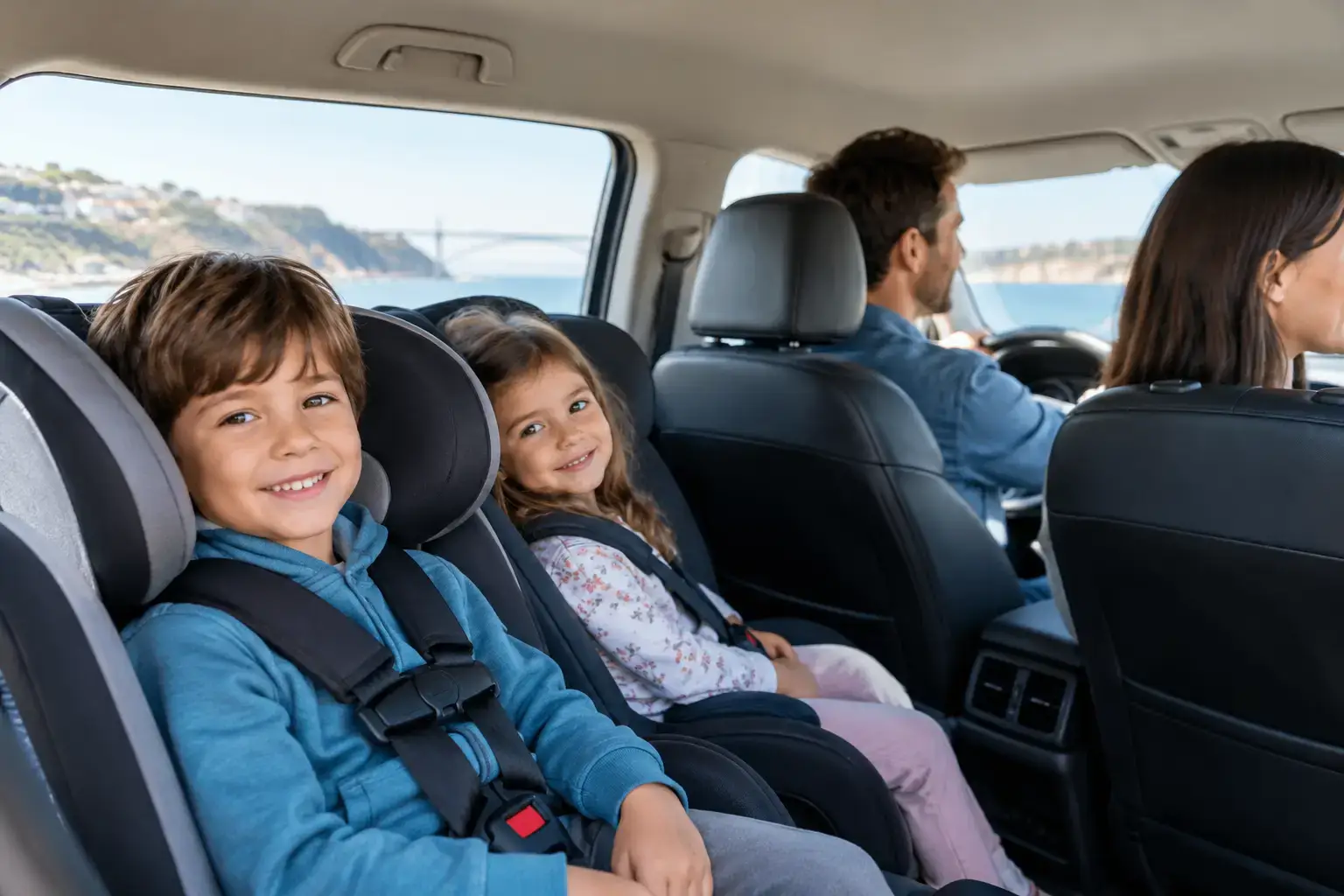
A family landing in Lisbon after an overnight flight has enough to manage before the first stop in the city. Luggage, pushchairs, tired children and the right transfer vehicle all need to work together. Understanding the Portugal child seat rules before you travel removes one avoidable uncertainty and helps make every journey, from the airport to Sintra or Porto, more comfortable.
Portuguese road rules use a child’s age and height together. For most visiting families, the practical message is straightforward: children under 12 years old who are less than 135 cm tall should travel in a suitable, approved child restraint system. The seat must fit the child and be correctly installed in the vehicle.
Portugal child seat rules: the basic requirement
In Portugal, children under 12 and below 135 cm are generally required to travel in the rear seats using an approved child restraint appropriate to their size and weight. This is the rule families should plan around when booking a hire car, private transfer or day tour.
The 135 cm threshold can surprise parents who are used to rules based mainly on age. A confident-looking nine or ten-year-old may still need a booster seat if they have not reached that height. Equally, a child who is tall for their age may fall outside this specific requirement, but that does not automatically mean an adult seat belt fits well. The belt should sit across the shoulder and chest, not against the neck, with the lap section low over the hips.
For younger children, an infant carrier, rear-facing seat, forward-facing child seat or booster will usually be needed, depending on the child’s height, weight and the seat manufacturer’s limits. Modern seats are commonly approved under UN R129, sometimes called i-Size, while some older approved seats follow UN R44 standards. The key point for visitors is not to choose a seat by appearance or age label alone: use one approved for the child’s measurements and follow its instructions.
Where children should sit in the vehicle
The rear seat is normally the right place for a child restraint. It is also the position assumed by the Portuguese rules for children under 12 and under 135 cm.
There are limited circumstances in which a child may travel in the front passenger seat. One commonly relevant example is a child under three travelling rear-facing in the front, but only when the passenger airbag has been deactivated. A rear-facing seat must never be placed in front of an active airbag.
There are also specific exceptions for older children where a vehicle has no rear seats, no rear seat belts, or where the rear seats are already occupied by other children. These are exceptions rather than the arrangement to request by default. For a family transfer, selecting a vehicle with sufficient belted rear seats is the simpler and safer plan.
If you are travelling with three children, do not assume that three seats will fit across any rear bench. The width of the vehicle, ISOFIX positions, seat-belt layout and the shape of each child seat all matter. Tell your transport provider each child’s age, height and weight before confirming the service. This allows the right vehicle and restraint configuration to be arranged rather than improvised at collection.
Taxis, private transfers and hired cars are not the same
Families often hear that taxis have different arrangements for child seats and conclude that a seat is unnecessary. That is not a safe assumption to carry into a holiday itinerary.
There are narrowly defined exceptions in Portuguese law for certain public passenger transport situations, particularly for children aged three and over travelling in the rear of a taxi. These exceptions do not make a taxi journey the best choice for a child who would ordinarily need a restraint. They also should not be confused with the standard expected for a pre-booked private transfer or a hired vehicle.
A private transfer gives you the opportunity to specify the family’s needs in advance. For an airport collection, provide the number of adults and children, each child’s age, height and weight, plus the amount of luggage and whether you are bringing a pushchair. If you have a preferred rear-facing seat or a child with particular support needs, raise this when booking, not when the driver arrives.
With a hire car, check what is actually included. A booking that says “child seat available” may still require you to reserve the category, confirm the price, and fit the seat yourself. Families who bring their own seat should check airline carriage rules and make sure it is compatible with the car they have reserved. A seat secured by ISOFIX in one vehicle may need to be installed with a seat belt in another.
Choosing the right seat for your child
A child restraint works only when its limits match the child and it is fitted properly. This is especially relevant when you are changing vehicles during a multi-stop holiday.
For babies and very young toddlers, rear-facing travel offers valuable protection for the head, neck and spine. Keep a child rear-facing for as long as their approved seat allows. For older children, a high-back booster is often a better choice than a basic booster cushion because it helps position the shoulder belt correctly and provides side support.
Avoid moving a child into the next seat category too quickly just because it seems more convenient. A bulky winter coat can also affect how tightly a harness sits, although Portugal’s mild climate means this is less often an issue than on a UK winter departure. Use light layers and check that the harness lies flat and snug.
A few quick checks before departure can make a real difference:
- The restraint is approved and suitable for the child’s current height or weight.
- The vehicle seat belt or ISOFIX fittings are compatible with that restraint.
- The harness is tightened correctly, or the adult belt follows the booster’s guides.
- A rear-facing seat is never used in front of an active airbag.
- Everyone travelling is counted when choosing the vehicle, including infants and luggage.
Planning family journeys around Portugal
Portugal is compact on a map, but road journeys can include hills, winding coastal sections and longer stretches than expected. The route from Lisbon to Sintra is short, yet traffic and narrow roads can extend the journey. A day combining Fátima, Nazaré and Óbidos requires more time in the vehicle, while Lisbon to Porto is a proper intercity transfer.
For these days, comfort matters alongside compliance. Ask for breaks that suit your children, particularly with babies and toddlers. A private itinerary can allow time for a snack, a toilet stop or a few minutes outside rather than asking a child to remain settled for hours. For very young babies, follow the guidance supplied with their particular car seat and avoid treating long periods in the carrier as ideal simply because the journey is convenient.
If motion sickness is a concern, mention it when planning the route. A calmer pace, sensible seating position and breaks can help more than trying to rush through a full-day programme. A family’s best itinerary is not the one with the most stops, but the one that leaves enough energy to enjoy each one.
What to confirm before booking a transfer
The simplest way to avoid confusion is to send complete information at the reservation stage. State the collection and drop-off locations, travel date, number of passengers, luggage, and each child’s age, height and weight. Confirm how many child restraints are requested and whether any child needs to remain rear-facing.
It is also sensible to ask whether the seats will be fitted before collection and whether the planned vehicle has enough space for every passenger and bag. For a larger family, a people carrier may be more appropriate than a saloon, even if the passenger count appears to fit on paper. Space between seats and room for a folded pushchair can change the experience considerably.
When using a specialist local service such as PortuCaleTravel, clear information before the journey helps the team organise a private transfer around the family, rather than asking the family to adapt at the kerbside. That support is particularly useful after a long flight or when linking several destinations in one trip.
Rules and vehicle specifications can change, so check the current requirements with your transport provider or the relevant Portuguese authorities before departure. Then let the details do their quiet work: with the right seat, the right vehicle and a little room in the schedule, the road between Portugal’s favourite places becomes part of the holiday rather than a logistical worry.