
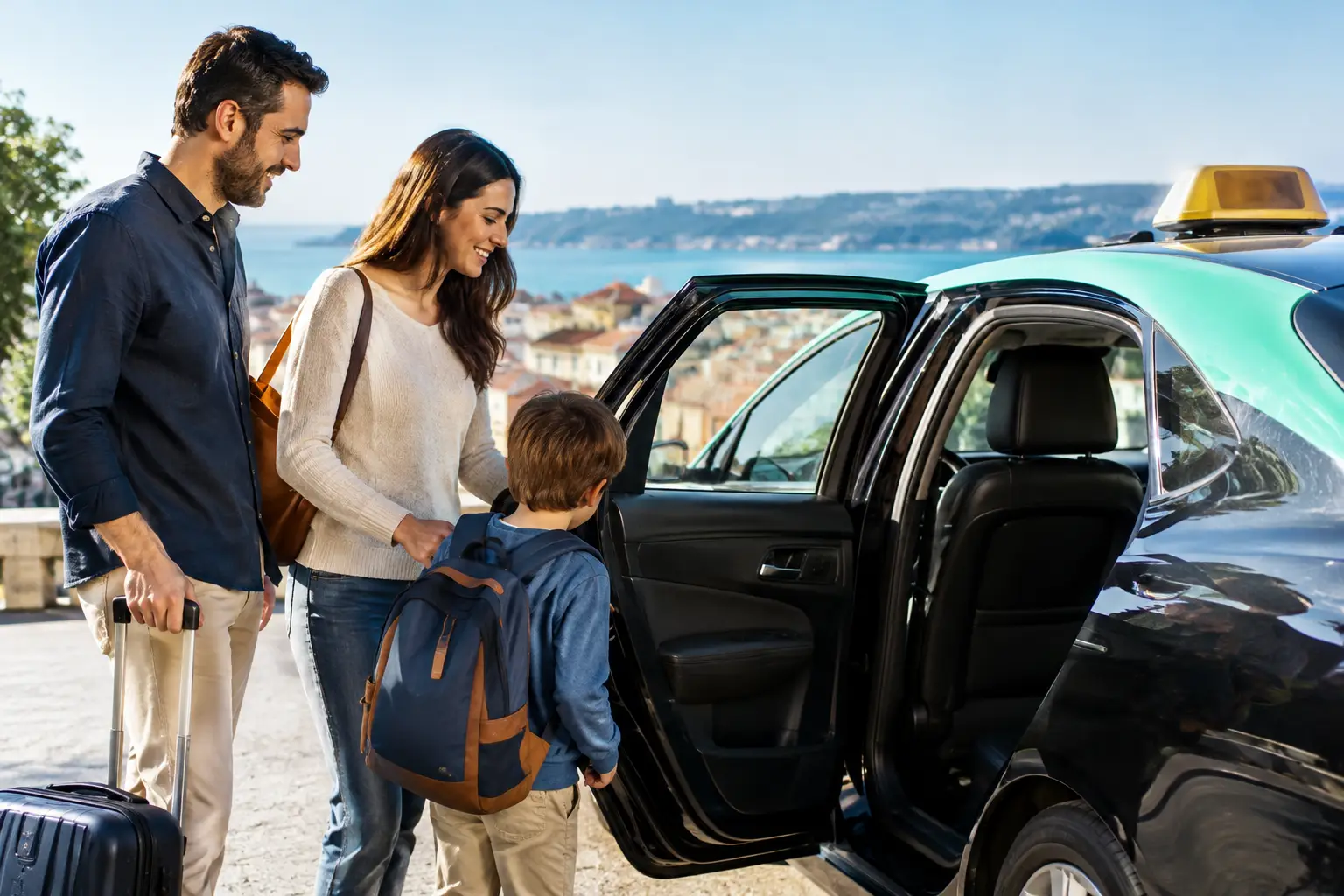
Landing in Lisbon after a long flight with a tired toddler is not the moment to discover that the taxi rank has no child seat available. So, are Portuguese taxis child-friendly? They can be, but a standard taxi should not be treated as a guaranteed family-ready transfer. The difference lies in how you book, your child’s age and height, and whether an appropriate restraint has been arranged in advance.
For Brazilian families travelling through Portugal, this detail matters from the airport onwards. A well-planned transfer removes the uncertainty of collecting luggage, locating the right vehicle and deciding whether a last-minute journey is suitable for your child. It also gives you more freedom to enjoy destinations such as Lisbon, Sintra, Cascais, Fátima and Porto at a comfortable pace.
Are Portuguese taxis child-friendly in practice?
Portugal is generally an easy country for families to visit. Drivers are accustomed to international visitors, urban journeys are relatively straightforward, and taxis are widely available in major cities. However, child friendliness is not the same as child-seat availability.
Most conventional taxis do not routinely carry baby seats, toddler seats or booster seats. If you hail a taxi in the street or join an airport taxi queue, the vehicle will usually have standard rear seat belts but may not have the right restraint for your child. This can be inconvenient at best and a safety concern at worst, especially after a flight or on a longer trip.
A pre-booked vehicle with the correct seat is a much better option for families. When reserving, give the child’s age, height and approximate weight, rather than simply requesting a “child seat”. These details help the transport provider prepare an appropriate restraint and allocate a vehicle with enough space for pushchairs, suitcases and hand luggage.
Portugal’s child-seat rules: what parents should know
Portuguese road rules require children under 12 years old and under 135 cm tall to use an approved child restraint suited to their size. In most private cars and pre-booked transfers, this means a rear-facing baby seat, forward-facing child seat or booster seat as appropriate. Children should normally travel in the rear seats.
There are specific exceptions for passenger vehicles for hire, including taxis. In certain circumstances, a child may travel in the back without a child restraint or, depending on age, using the vehicle’s adult seat belt. These exceptions do not mean that travelling without a suitable seat is the best choice. They recognise the practical reality of an on-demand taxi service, not the ideal safety arrangement for a family holiday.
For parents, the practical message is simple: the legal exception should not be your plan A. If your child still uses a car seat at home, arrange one for transport in Portugal whenever possible. A properly fitted seat offers far more protection than relying on an adult belt that may not sit correctly across a smaller child’s shoulder and hips.
When a standard taxi may be enough
There are situations where a normal taxi can be a workable option. A short, low-speed urban ride with an older child who is tall enough to wear an adult belt correctly is very different from a motorway transfer from Lisbon Airport to Cascais or a full-day outing to Sintra.
Families with children who no longer need a booster seat may find taxis convenient for occasional journeys in central Lisbon or Porto. You can also use a taxi when plans change unexpectedly, such as leaving a restaurant late or returning to your hotel after a child becomes tired. Even then, check that the rear belts are accessible and functioning before setting off.
The trade-off is predictability. You may save time by taking the first available taxi, but you give up certainty about the vehicle size, boot capacity, child restraint and driver’s ability to accommodate a pushchair. For a family of four or five with luggage, that uncertainty can quickly become stressful.
Airport arrivals and long-distance travel need more planning
Airport transfers are where advance arrangements make the greatest difference. Lisbon, Porto and Faro airports all receive many families, yet an airport taxi queue cannot promise a car seat or a large vehicle at the exact moment you arrive. Bringing your own seat is possible, but carrying it through airports, hotels and historic streets can be cumbersome, particularly if you do not plan to hire a car.
A pre-arranged private transfer solves several practical issues at once. Your driver can meet you at the agreed point, the vehicle can be sized for the group and luggage, and the requested child seats can be fitted before you arrive. This is particularly valuable for babies, children who sleep during journeys, and families travelling with multiple suitcases.
The same principle applies to day trips. The roads to Sintra include curves and changing gradients, while journeys to Fátima, Nazaré, Óbidos or Porto can involve motorway travel. These are not the moments to compromise on a child’s usual travel safety. A private vehicle also allows sensible pauses for snacks, toilets or a change of clothes without having to reorganise an entire group itinerary.
How to book family-friendly transport in Portugal
When you contact a transport provider, be specific. Ask whether the seat will be supplied, installed before collection and suitable for your child’s age, height and weight. Confirm whether it has a five-point harness or is a booster, and explain if you need a rear-facing seat for an infant.
Also confirm the number of passengers, suitcases, pushchairs and car seats. A compact saloon may be comfortable for two adults and one child, but it may not have enough boot space for a travel buggy and several large cases. Larger families often benefit from a people carrier or private van, particularly when travelling between cities.
It is sensible to book both outbound and return airport transfers if your flight times are fixed. That way, you avoid having to repeat the child-seat question when leaving Portugal, often at an early hour when everyone is focused on getting to the airport.
Questions worth asking before you confirm
Before payment, make sure you know the answer to these points:
- Is an approved baby, child or booster seat included in the booking?
- Is the seat appropriate for my child’s age, height and weight?
- Will it be fitted before collection, and can the driver check that it is secure?
- Does the vehicle have sufficient space for our luggage and pushchair?
- Can the route include a comfort stop if we are travelling beyond the city?
These questions are not excessive. They are the difference between a transport booking and a family travel plan.
Taxis, ride-hailing apps and private transfers
Taxis are not the only option in Portugal. Ride-hailing apps can be useful in Lisbon and Porto, but child-seat availability still varies and may depend on the vehicle category. Do not assume that selecting a larger car automatically means a child restraint will be provided. Read the booking details carefully and cancel or rebook if the service cannot meet your requirements.
For a planned itinerary, private transfers offer more consistency than taxis or on-demand cars. The same is true for families who want to combine transport with sightseeing rather than manage separate journeys between each stop. A private tour can be adapted around nap times, meal breaks and the energy levels of younger travellers, while keeping luggage and child equipment in the vehicle.
PortuCaleTravel can arrange private tours and transfers with local support, helping families coordinate suitable vehicles and child-seat requests before they arrive. For parents, the advantage is not only the seat itself. It is knowing that someone has considered the route, timing, group size and practical needs behind the journey.
A realistic approach for different ages
With a baby or young toddler, book every significant road journey in advance with a correctly sized seat. This is the least flexible stage of family travel, but careful planning pays off quickly. For preschool children, a harnessed seat or booster remains essential depending on their size, and a longer transfer is usually easier when they have their familiar level of support and comfort.
School-age children may need only a booster, but do not make that decision based on age alone. Height and belt fit matter. If the shoulder belt crosses the neck or face, or the lap belt sits over the stomach rather than low across the hips, the child is not ready to travel safely with an adult belt alone.
Teenagers can usually use standard seat belts, although they may still appreciate the space and quieter pace of a pre-booked transfer after a busy day of sightseeing. Every family’s needs are different, which is why a one-size-fits-all taxi solution rarely works perfectly.
Portugal is wonderfully welcoming for family holidays, but family-friendly transport needs to be arranged with the same care as your hotel and itinerary. Plan the first ride before you fly, request the right child restraint and leave the airport knowing the journey ahead is already taken care of.